Walking the talk for 50 years: how our offices shape better design
The new workplace of our head office, redefining collaboration, sustainability, and inclusivity in Newcastle’s city centre.

Authors

For 50 years, Cundall has treated its offices as living laboratories: places to test ideas, measure performance and strengthen expertise. By designing and occupying its own workplaces, the practice has used them to prove the principles it advocates to clients.
This commitment continues with the relocation of Cundall’s global head office in Newcastle, a move that signals the future of workplace design and the responsibility designers hold in shaping it.
A new chapter in Newcastle
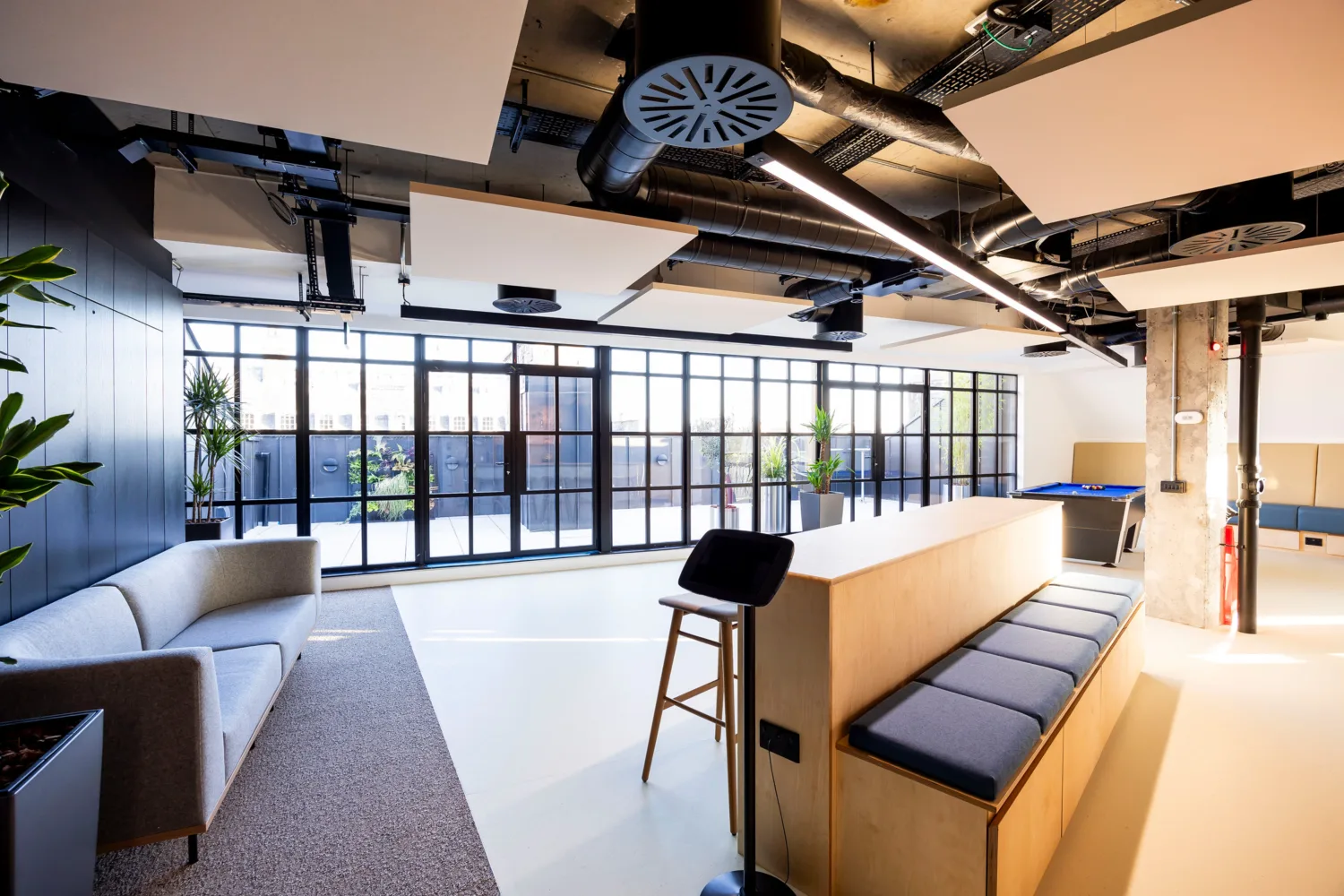
The new Newcastle head office at Bank House is shaped by circular economy thinking, biophilic design, low embodied carbon and productivity. Materials were reused or repurposed where possible, while new selections prioritised durability and low carbon impact. Natural light, planting and flexible spaces support wellbeing and collaboration.
The office also functions as a measurable test bed, enabling teams to observe how design decisions influence energy use, behaviour and performance over time.
Proving low energy design works
Low energy offices reduce operational carbon, lower running costs and demonstrate that high performance design can be achieved in everyday workplaces.
Cundall’s new Edinburgh office has the the lowest carbon emission Category B office fit out that Cundall has assessed.

Cundall offices have repeatedly tested low energy design. In Belfast, high efficiency heat recovery significantly reduced energy intensity. The Dubai office cut lighting energy consumption by 45 percent, while Edinburgh’s New Clarendon is the lowest-carbon Category B office fit-out Cundall has assessed.
Putting circularity into practice
Circular economy approaches reduce embodied carbon, extend material life and challenge designers to rethink value beyond first use.
In 2012, the Sydney office created furniture sourced from reclamation yards.

Circular economy principles have also shaped Cundall workplaces. In Sydney, furniture was made from reclaimed pallets, drums and doors, encouraging designers to reconsider material value and lifecycle. Hong Kong incorporated timber from an old fishing trawler as a feature wall, connecting reuse with local history. In Dublin, bespoke furniture used 100 percent recycled materials, including sit-stand desks relocated from Shanghai.
Cundall Hong Kong office included a feature wall which utilises reclaimed wood from an old Hong Kong fishing trawler that once worked the South China Sea.

Leading the way on healthy building standards
Green building ratings provide a consistent, independent framework for measuring performance and allow design teams to learn how sustainability targets translate into real world outcomes.
Green ratings provide an independent framework for measuring performance and improving practice. An early Sydney office was the first in the Southern Hemisphere to achieve LEED Platinum, while One Carter Lane in London became Europe’s first WELL Gold certified office. Giving the practice early, firsthand insight into how international rating frameworks could be applied in a local context.

Designing healthier workplaces
Healthy workplaces support people to perform at their best, improving retention, productivity and overall organisational resilience.
Health and wellbeing remain central. At One Carter Lane, low- or zero-VOC materials supported better indoor air quality. In Qatar, Cundall delivered the country’s first office to achieve the WELL Building Standard, translating global best practice into a new regional context.
Birmingham city centre’s first WELL Gold certified office.

Making sustainable travel the easy choice
Access to active and public transport supports healthier lifestyles, reduces emissions and strengthens connection to clients and communities.
Location choices increasingly prioritise public and active transport. Belfast is less than three minutes from Belfast Grand Central Station, Birmingham’s city-centre move brought the team closer to clients and transport, and Manila’s relocation to the Ayala Triangle encourages public transport use.
Giving existing buildings a new future
Adaptive reuse reduces embodied carbon, preserves cultural value and demonstrates how existing buildings can be reimagined for modern work.

Adaptive reuse reduces embodied carbon while preserving cultural value. Edinburgh’s New Clarendon sits within a UNESCO World Heritage site, while Manchester’s Fourways House transforms a Grade II listed former warehouse into a flexible, high-performing workplace.
Prioritising acoustics
Good acoustic design supports concentration, collaboration and wellbeing, particularly in flexible and open plan workplaces.
Acoustic zoning and careful spatial planning support both concentration and collaboration. This was important at One Carter Lane and in the post-pandemic redesign of Fourways House, where teams needed a balance of focused and shared spaces.
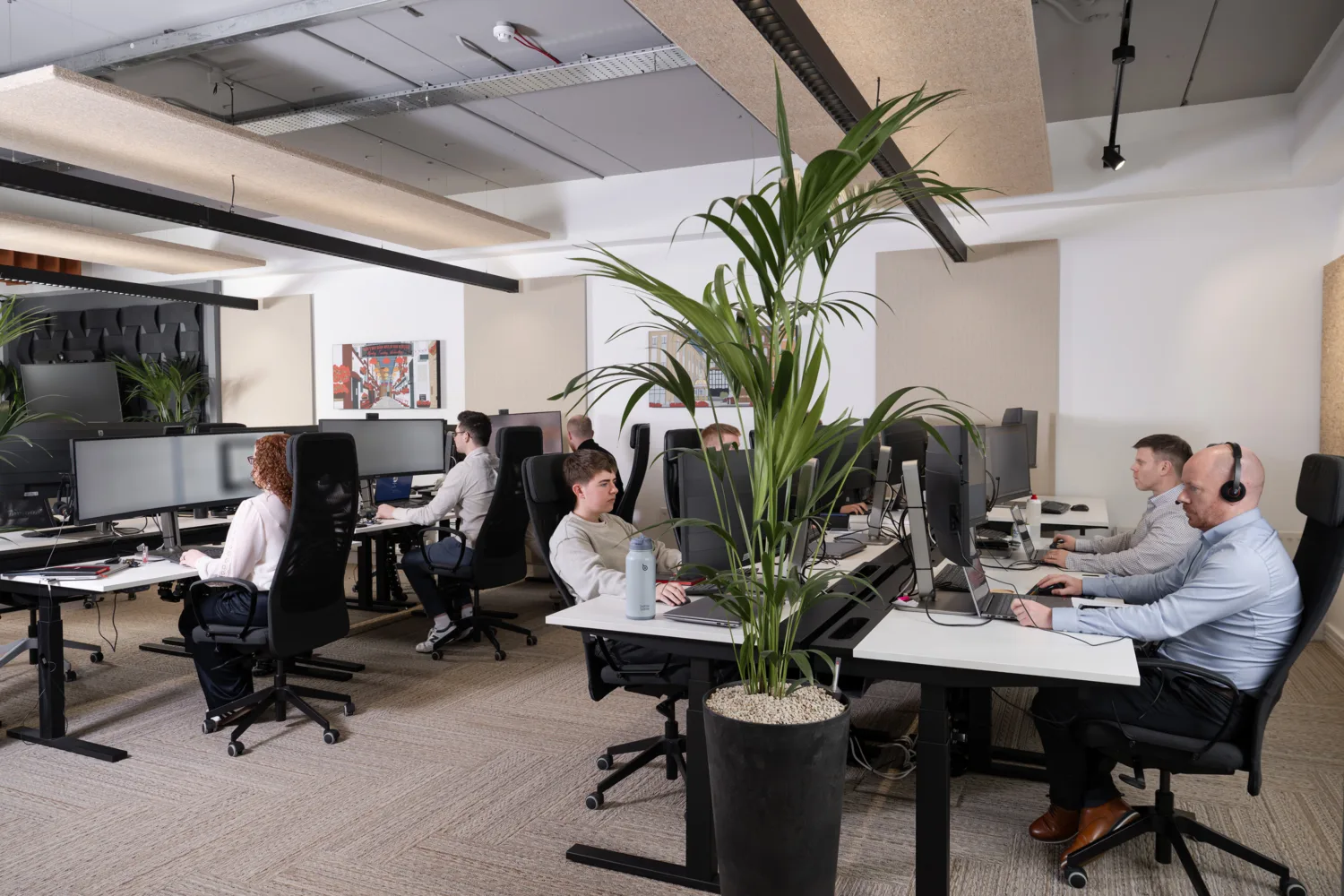
Manchester provides the perfect blend of agile workstations with spaces for our staff to collaborate.

Well-designed IT and AV systems enable seamless collaboration, support hybrid working and allow workplaces to adapt as technology and behaviours change.
Integrated IT and AV systems enable hybrid collaboration and adaptable layouts. Manchester and Dublin demonstrate how digital connectivity can support changing work practices rather than constrain them.
We are now connecting the use of Wi-Fi to our Zero Carbon Design 2030 approach see What is a Wi-Fi-first design and how can it enable a more sustainable workplace? - Blog - Cundall for more.
Offices as a continuous feedback loop
What unites these projects is the belief that designers improve by experiencing the outcomes of their decisions. Cundall’s offices are observed, reviewed and refined, creating a feedback loop that benefits people and clients.
Working in spaces that embody its recommendations also creates accountability. Performance is visible, lessons are shared and innovation is grounded in lived experience.
Looking ahead
As Cundall marks 50 years, its offices trace the profession’s evolution, from reclaimed materials to circular strategies, wellbeing standards and data-led performance.
The new Newcastle global head office is the latest expression of this journey. It reinforces Cundall’s commitment to learning, experimentation and leading by example, and the idea that shaping better buildings starts at home.