The story of the Canopy


Originally written for and published in Concrete Magazine in July 6th 2025. Authors include Richard Buswell of Loughborough University and Rasti Bartek and Vera Sehlstedt of Cundall.
The Canopy is the result of over five years of collaborative research between Loughborough University’s School of Architecture, Building and Civil Engineering and industry partners Cundall (structural engineering) and Foster + Partners (architecture), funded by UK Research and Innovation. It is the world’s first structure designed and manufactured using hybrid 3D concrete printing (h-3DCP) – a combination of additive 3D concrete printing and subtractive CNC milling. This approach allows for highly accurate, architectural-scale components to be produced directly from digital models, offering unprecedented flexibility in design and manufacturing, Richard Buswell of Loughborough University and Rasti Bartek and Vera Sehlstedt of Cundall report.
The Canopy showcases these above capabilities. Comprising five precisely manufactured components, it demonstrates how new jointing and assembly approaches can be integrated into complex geometries, enabling disassembly and reuse. It also allows seamless integration of functional features such as electrical conduits and rainwater collection, reducing production time, material use and cost.
h-3DCP technology
The Loughborough University production cell uses a 2.55m reach, 185kg payload ABB robotic arm, combined with a 1.5 × 2.5m aluminium print bed and turntable. Objects up to 2.7m tall can be printed.
Two material systems are used:
- 1K system: conventional batching for large, flat panels.
- 2K system: accelerated curing for tall objects, ensuring stability during vertical growth.
Both systems use a special printing head and dedicated pump, with selection based on project needs.
Description of the structure
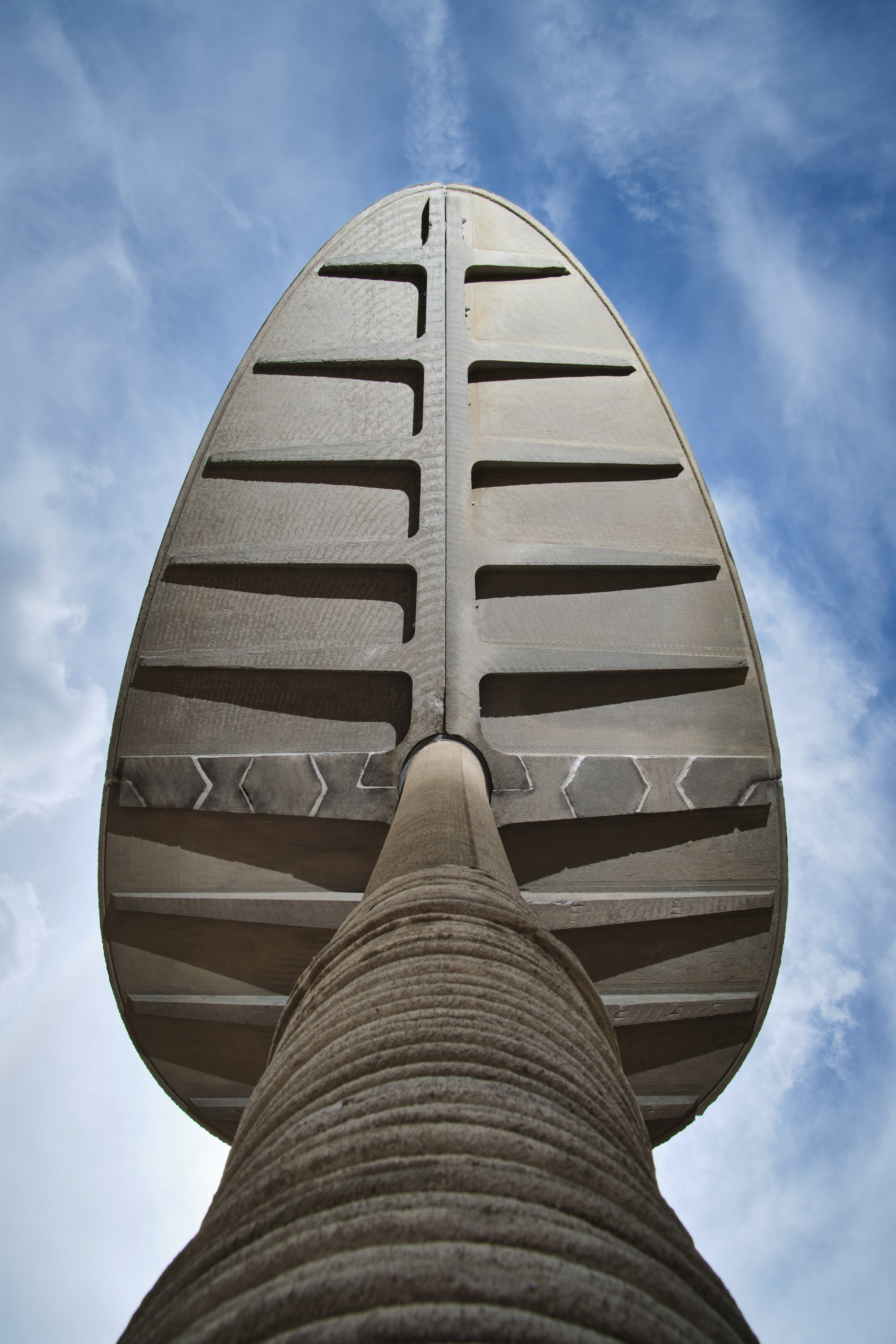
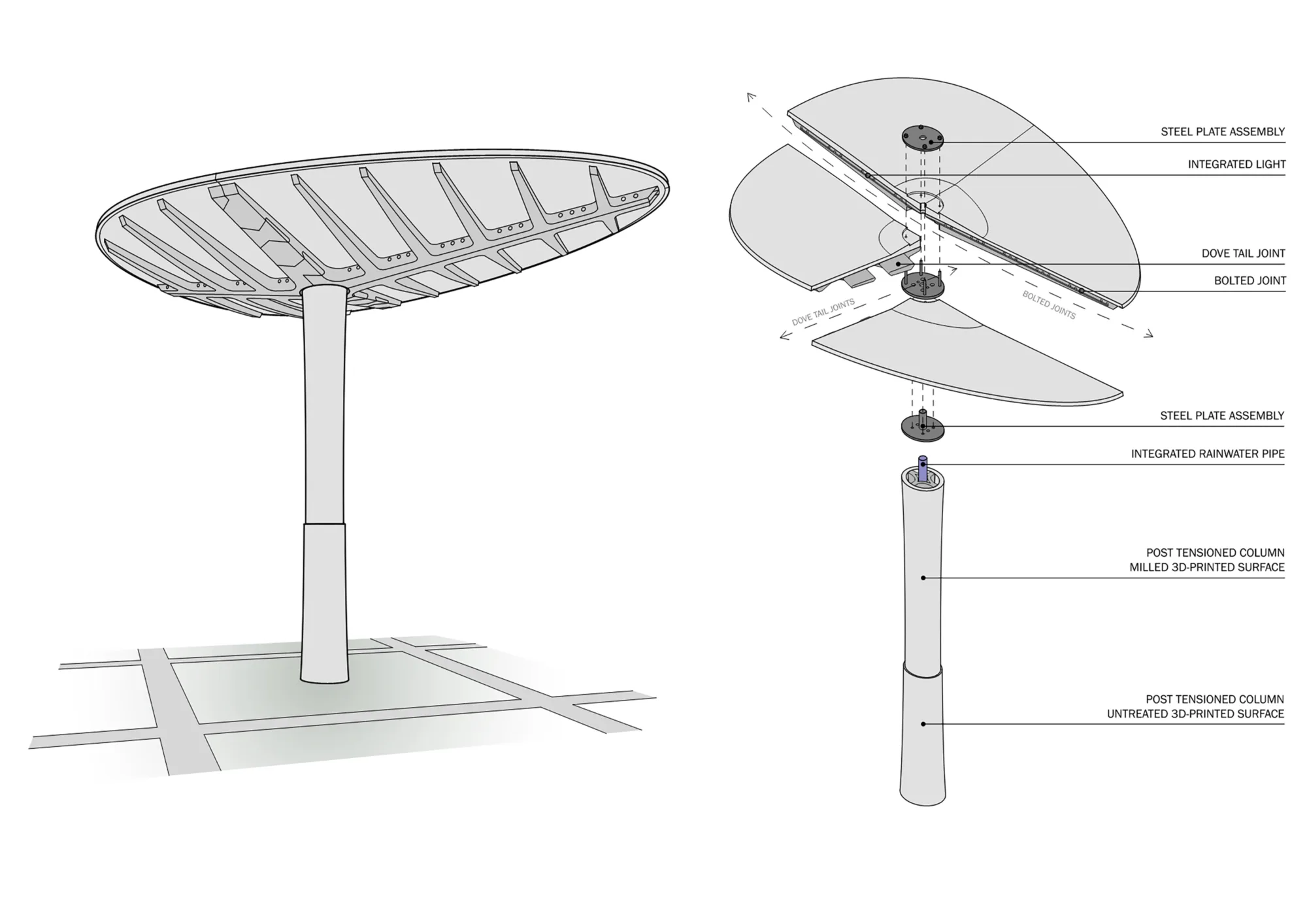
The Canopy’s roof consists of four h-3DCP panels reinforced with textile mesh. Panels are bolted together along their length and interlocked with concrete dovetail joints across their width – a technique rare in concrete due to tight tolerances. Bolts are post-tensioned for added clamping force. A circular chamfer at the panels’ inner corners creates a central hole to accommodate a steel spigot welded to the column’s end plate.
The hollow concrete column, also h-3DCP, contains four internal steel bars for post-tensioning, maintaining compression without conventional reinforcement. It also conceals a rainwater downpipe and power/data conduits. The column connects at the base to a steel plate offset from the reinforced concrete (RC) pad foundation, accommodating service bends.
Structural analysis/design
The final geometry was developed iteratively through architectural design, structural engineering and laboratory testing. Constraints such as robotic reach, tool access, print/mill times and fresh concrete properties influenced the design. The aim was to push h-3DCP’s capabilities while remaining practically achievable.
Initial structural analysis used Autodesk Robot Structural Analysis and Grasshopper parametric scripts to explore multiple geometries quickly. Topology optimisation refined rib tapering and shell thickness for efficiency. The Canopy roof shell is perfectly balanced around the column, with no self-weight-induced bending moments, meaning the column only resists wind, snow and accidental loads.
Joint design was carefully studied: dovetail geometry was optimised for uniform stress distribution and minimum clamping forces for the bolted joints were calculated. Final non-linear 3D finite-element (FE) models were developed in Autodesk Fusion 360 Nastran and independently verified using ATENA software.
Robotic fabrication process
The Canopy demonstrates the synergy between additive 3D printing and subtractive CNC milling. The process begins with cutting a former to shape the double-curved panel. 3D printing follows in conformal layers, pausing for textile mesh reinforcement insertion. CNC milling achieves a high-precision finish and features like joints, service channels and drainage elements – all integrated digitally, without additional materials or processes. Precision was validated through structured light scanning against CAD models. Most deviations were within ±2mm, with only minor outliers of +3 to +5mm, primarily at joint edges and mating surfaces. This seamless integration of design, material science and manufacturing control offers a new paradigm for construction – one that is smarter, leaner and more adaptable.
Load testing
Given the novelty of 3D printed concrete and its anisotropic properties, physical load testing was essential. Tests verified global behaviour and ultimate limit states (ULS) for the canopy roof and column separately. Detailed 3D FE models informed load testing at incremental stages. Strain gauges and linear variable differential transformers (LVDTs) measured responses, and multiple test repetitions confirmed behaviour, including elastic recovery after unloading.
Permanent monitoring systems were also installed to study long term effects, including weathering and UV exposure.

Sustainability
h-3DCP offers a significant step toward reducing waste and environmental impact in construction. By eliminating the need for moulds, it saves material, cost and production time. It allows for structurally optimised designs using only the necessary amount of material – evident in The Canopy’s variable shell thickness, tapered ribs, hollow column and integrated conduits for electrical cables, and other features such as drip details – which would be highly complex and wasteful to produce with traditional casting. The ability to design for assembly and disassembly promotes circularity, potentially extending component lifespans and reducing embodied carbon. Early-stage CNC milling during curing reduces energy requirements compared with hardened concrete milling. Ongoing PhD research is quantifying the embodied energy, material savings and carbon footprint of h-3DCP compared with conventional methods, with the aim of enabling data-driven progress toward net zero construction.


