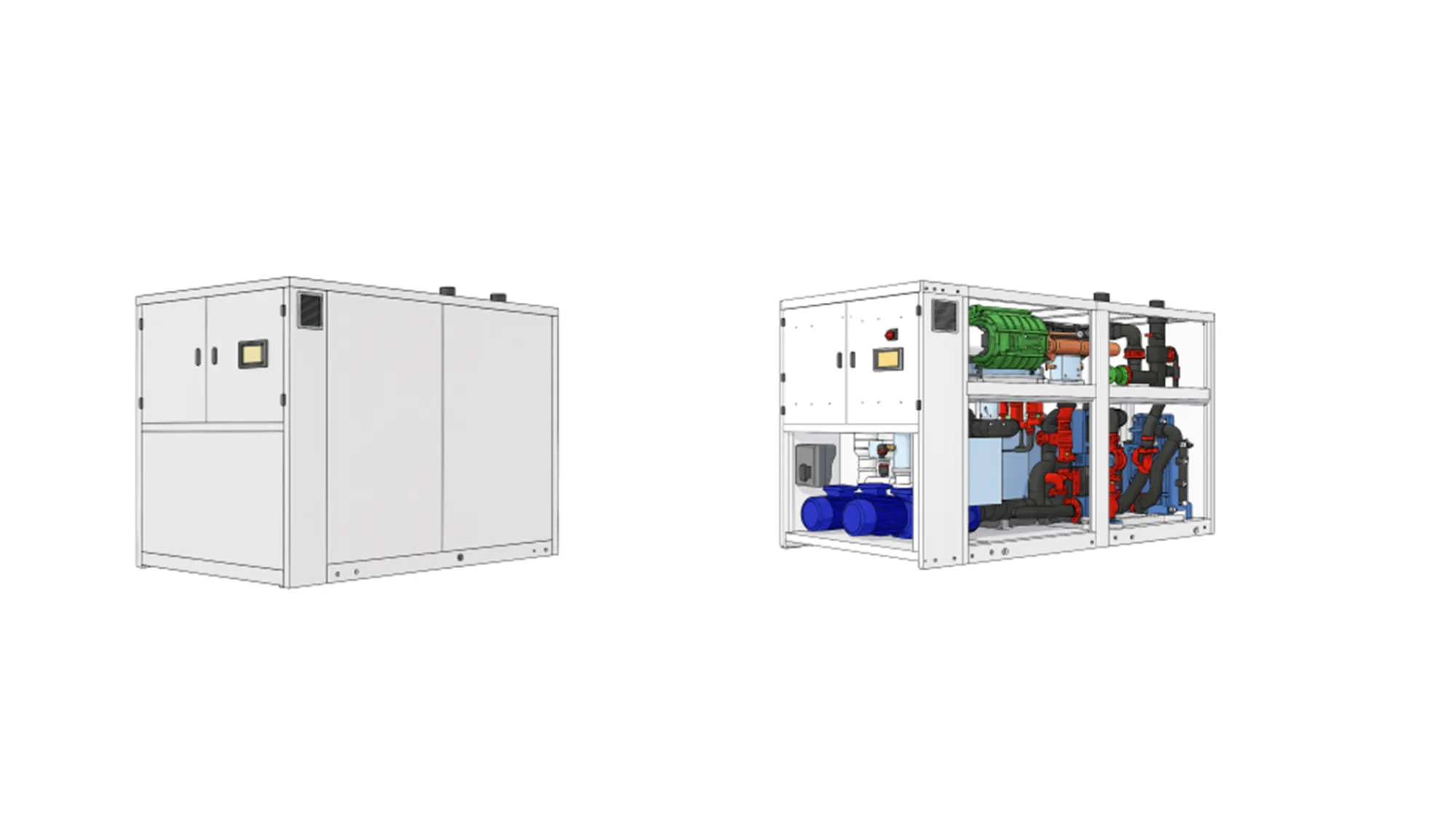
Assessing compressor-assisted CDU integration for existing data centres
Evaluating liquid cooling deployment pathways for existing air-cooled hyperscale data centre environments.

As demand for AI and high-performance computing continues to grow, liquid cooling is becoming an increasingly important consideration for existing data centres. We were engaged by one of our key hyperscale clients to assess the feasibility of incorporating compressor-assisted coolant distribution unit (CA-CDU) technology into their existing air-cooled data centres and to propose enhancements identified during the product development stage.
With our multi-disciplinary and data centre project delivery experience, we were able to identify how the CA-CDU could be refined and deployed effectively in the client’s facilities and advise on the wider design and operational impacts of this interesting and versatile technology.
A key focus of the assessment was understanding how the CA-CDU performs under different operating conditions. The unit operates in three cooling modes depending on ambient temperature:
- 100% free-cooling mode: When the ambient temperature is at least 2°C lower than the temperature of the technical water supply delivered to the liquid cooled racks (typically around 30 °C), the unit operates in free-cooling mode. In this mode, the compressor is turned off, and the water-cooled condenser is bypassed, allowing the dry air cooler to provide the required cooling capacity directly to the technology cooling system via the CDU’s heat exchanger.
- Mixed mode: When the prevailing ambient temperature is between 2°C below the technical water supply temperature and 5°C below the technical water return temperature, the unit operates in mixed mode. In this mode, the dry air cooler provides as much free cooling as possible, while the compressor operates at part-load to provide trim cooling and compensate for any overall capacity shortfall.
- 100% mechanical mode: When the prevailing ambient temperature is less than 5°C below the technical water return temperature (typically around 40°C), the unit operates in mechanical cooling mode. In this mode, the compressor is active and adjusts its capacity based on the prevailing cooling demand and the setpoint of the technical water delivered to the liquid cooled racks.

Working on this project gave our specialist data centre research and development team the opportunity to work alongside the cooling specialist, and our client to contribute technical insight that directly led to design improvements.