Circle Forward: Lessons from London, Solutions for Scotland


Across the UK built environment, circular economy is no longer a niche conversation. The question has shifted from whether we should retain, reuse, repair and design out waste, to how we make those decisions normal, reliable and commercially viable on real projects. That was the starting point for Cundall’s Circle Forward conversations in London and Edinburgh, and for the World Green Building Week panel exploring Scotland’s path to circular construction.
Taken together, the discussions point to a clear conclusion: Scotland should not simply copy London’s approach. London shows what happens when planning, policy pressure and market density start to create demand for circularity. Scotland’s route needs to respond to a different context. It is a smaller and more dispersed market, with strong public-sector influence, valuable heritage assets and an emerging policy landscape that still needs to be translated into practical delivery.
London: demand is being created earlier
The London roundtable reflected a market where circularity is increasingly pulled into the earliest stages of a project. Planning requirements, circular economy statements, pre-demolition audits and material passport expectations are beginning to make reuse visible before the procurement route, specification and programme are fixed. That matters because circularity becomes harder to deliver when it appears as a late aspiration rather than a defined project requirement.
London participants also highlighted the importance of evidence and story. Circularity needs testing, traceability and clear definitions so that “reuse” is not confused with recycling or vague good intent. But it also needs to be made desirable. Reused materials can carry social value, carbon savings, leasing appeal and a stronger narrative for tenants and communities. When circularity is presented as a design asset rather than a compromise, it becomes easier for clients to support.
Scotland: the challenge is delivery confidence
The Edinburgh discussion brought a different emphasis. Scotland has strong ambition, but circularity is not yet consistently translated into planning conditions, funding rules, procurement requirements or contracts. When circularity is introduced after budgets and contracts are set, it becomes a risk issue rather than a design opportunity: contractors, suppliers and designers are asked to deliver something that has not been allowed for in time, cost or responsibility.
That risk is not abstract. Warranty, insurance, certification, fire requirements, waste classification, programme pressure and the absence of reliable benchmark data for specialist systems such as MEP and heat networks all came through as practical blockers. As discussed during the panel event, “circularity needs to be trusted before it can become normal”; these are the mechanisms that give project teams permission to specify reused or innovative materials with confidence.
Yet the Edinburgh discussion was not pessimistic. It showed that Scotland’s scale can be an advantage. A smaller market can move quickly when the right people are connected, and its collaborative culture can turn conversations into practical exchanges of materials, knowledge and opportunities. Scotland may not have London’s volume of projects, but it has the potential for more direct material matching and shared learning between organisations that already know how to work together.
What Scotland can take from London
The comparison between London and Scotland suggests that the pathway is not one action, but a connected delivery system. The discussions pointed to eight enablers, which can be understood through four practical conditions: setting the ask, building trust, enabling delivery and making circularity normal across the market.
Scotland's circular construction pathway
A four-part framework to embed circularity across Scotland's built environment
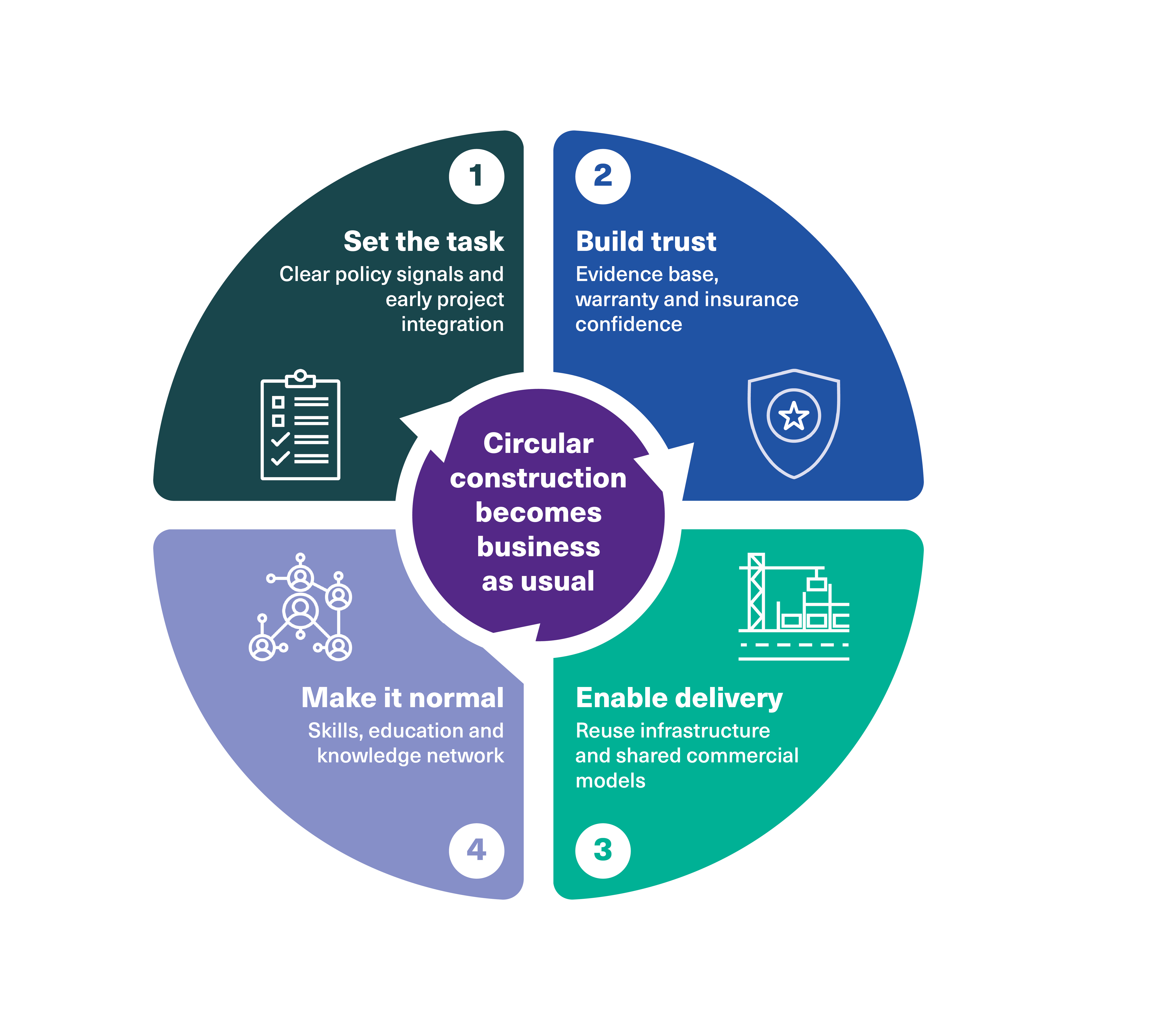
The most immediate opportunity is to define the ask. Circularity cannot remain a broad ambition that every project interprets differently. One useful framing shared through the wider discussions was to think about circularity across the past, present and future of a building: the past is what can be retained or recovered from existing assets; the present is how we procure lower-impact, reused or recycled materials now; and the future is how we record, passport and design materials so they can be recovered again. In that sense, material passports are not only a data exercise; they are a way of protecting future value and making today’s materials useful to the next generation.
As was reflected in the panel discussion, “a landfill diversion metric alone is not enough” if recycling can still hide missed reuse opportunities. Scotland’s pathway therefore needs clearer definitions and more useful metrics that recognise retention, reuse, recycled content, adaptability and future recoverability, not simply waste avoided at the end of a project.
The second opportunity is to make circularity easier to deliver. That means pre-demolition audits that evolve from visual surveys into tested, decision-ready material inventories; platforms that connect supply and demand; regional hubs and temporary storage; and brokerage models that understand both material condition and project timing. It also means giving designers, graduates and site teams more practical exposure to how materials are installed, removed, repaired and reused, so circular intent can survive the realities of delivery. These systems only unlock value when they connect to real logistics, clear ownership, assurance routes and project governance.
The third opportunity is cultural. The repeated theme was confidence: confidence that reused materials can perform, that warranties can be resolved, that contractors can deliver, and that clients will see value beyond upfront cost. Demonstrator projects are essential here. Cundall’s Edinburgh office, for example, showed that a high-circularity fit-out can combine reused furniture, recycled and biobased materials, landfill diversion and low-carbon design, while also proving that reused materials can look normal, high quality and desirable when they are designed and communicated well.

A Scottish roadmap to a circular future
In the short term, Scotland can start by making circularity explicit in briefs, feasibility studies and early design gateways. In the medium term, it can build the enablers: shared audit formats, material data, reuse hubs, Scottish case studies, contractor input and practical training. Towards 2030, the aim should be to embed circularity into policy, procurement and contracts so that it sits alongside cost, carbon, programme and quality as a routine project metric. As was clear from the panel event, “Scotland’s advantage may be its ability to connect people, projects and materials faster.”
London demonstrates how policy can create momentum, but Scotland demonstrates why it must design its own delivery model. The opportunity now is to bring those lessons together: not by waiting for a perfect system, but by building the requirements, evidence, infrastructure and trust that make circular construction the easier choice. As pressure grows on raw materials and resource use, circularity becomes not only a carbon and waste strategy, but a resilience strategy for the future of construction. If Scotland can do that, circularity can become more than a specialist ambition. It can become part of how buildings are planned, procured, delivered, used and valued.
As Circle Forward continues, the next step is to take this conversation into other UK regions and test whether the same needs are emerging elsewhere. By comparing different markets, the campaign will build a clearer picture of what is shared, what is local, and what needs to change if circular construction is to move from isolated good practice to a more consistent UK-wide approach.


