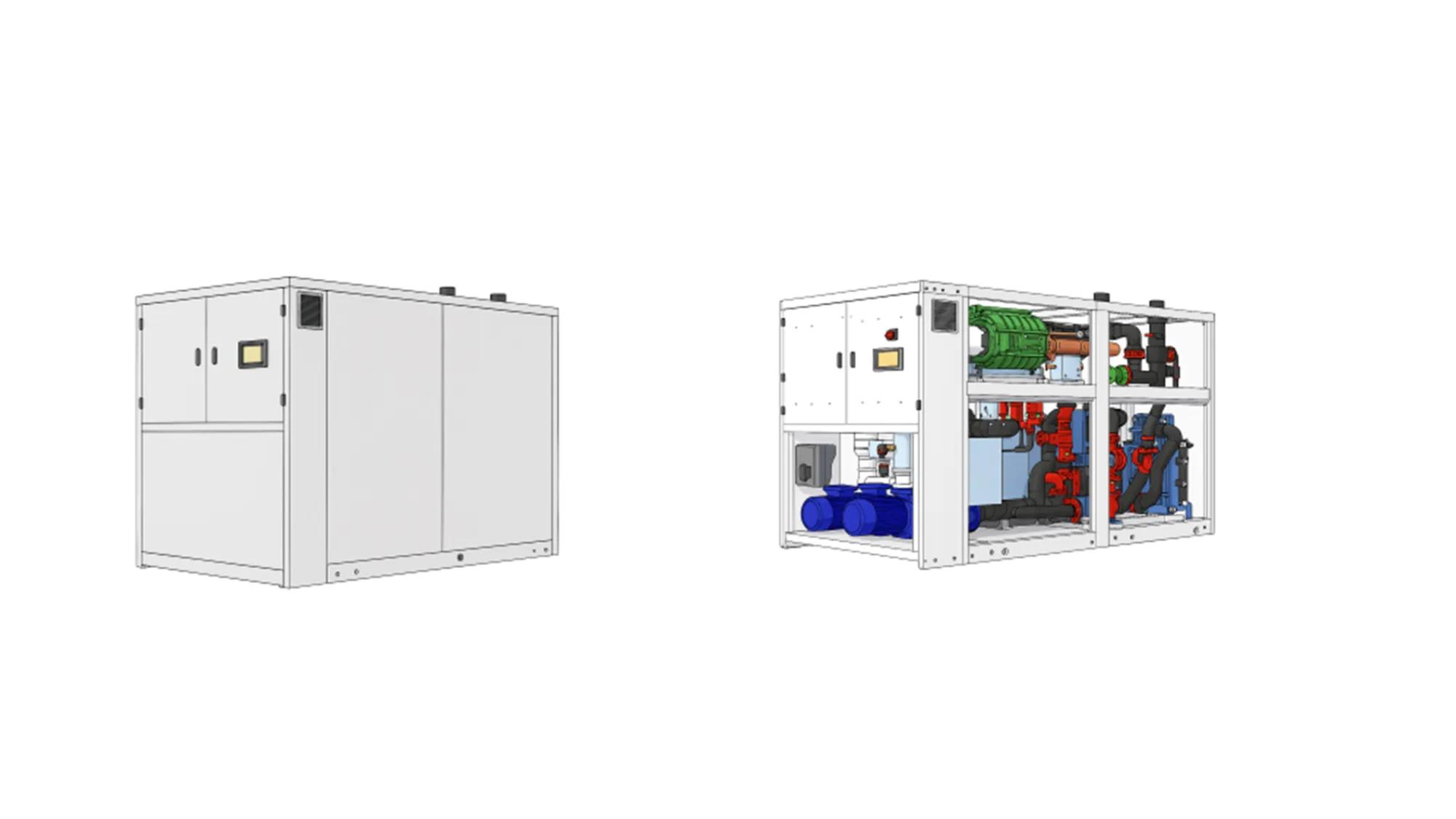
Compressor-Assisted Coolant Distribution Unit
We were engaged by one of our hyperscale clients to assess the feasibility of incorporating CA-CDU technology into their existing air-cooled data centres.

The demand for artificial intelligence and high-performance computing systems is continuing to rise. This is driving a transition away from air cooling to liquid cooling, due to the latter’s greater cooling capacity.
Coolant Distribution Units (CDUs) are typically an integral part of most liquid cooling systems, providing hydraulic separation between the Technical Cooling Systems (TCS) that serve the IT equipment racks, and the Facility Water Systems (FWS) that convey heat away from the data hall. Most CDUs currently on the market are configured to be connected to chilled water infrastructure, which acts as the FWS. However, many legacy data centres are served by direct or indirect air-cooling systems, and do not have a chilled water system. Even where chilled water is provided, it may not be possible to divert capacity away from existing Fan Coil Wall or CRAH units, for operational or logistical reasons. Alternatively, a chilled water supply may be available, but the operating temperature may not be appropriate for the types of IT racks under consideration.
In these situations, a Compressor-Assisted CDU (CA-CDU) can be a viable alternative. The CA-CDU includes the standard components of a traditional CDU, such as plate heat exchangers and pumps. However, these devices also feature an onboard refrigeration circuit, eliminating the need for chilled water infrastructure.
Heat rejection is provided by an external dry air cooler, that serves a water-cooled condenser within the CDU, via condenser water pipework. The CA-CDU operates in three different cooling modes, subject to the prevailing ambient air temperature:
- 100% free-cooling mode: When the ambient temperature is at least 2°C lower than the temperature of the technical water supply being delivered to the liquid cooled racks (typically around 30 °C), the unit operates in free-cooling mode. In this mode, the compressor is turned off, and the water-cooled condenser is bypassed to allow the dry air cooler to provide the required cooling capacity directly to the TCS, via the CDU’s heat exchanger.
- Mixed mode: When the prevailing ambient temperature is between 2°C below the technical water supply temperature and 5°C below the technical water return temperature, the unit operates in mixed mode. In this mode of operation, the dry air cooler provides as much free cooling as possible, while the compressor operates at part-load to provide trim cooling to compensate for any overall capacity shortfall.
- 100% mechanical mode: When the prevailing ambient temperature is less than 5°C below the technical water return temperature (typically around 40°C), the unit operates in mechanical cooling mode. In this mode, the compressor is active and adjusts its capacity based on the prevailing cooling demand and the setpoint of the technical water being delivered to the liquid cooled racks.
Cundall were engaged by one of our key hyperscale clients to assess the feasibility of incorporating CA-CDU technology into their existing air-cooled data centres and to propose enhancements identified during the product development stage. With our multi-disciplinary experience of full, end-to-end delivery of data centre projects, we were able to identify how the CA-CDU could be refined and effectively deployed into the client’s facilities, and to advise on the wider design and operational impacts of this interesting and versatile technology.